Museums of Computing
Palgrave Macmillan · London 2026

Museums of Computing

Stewardship of Digital Heritage

by Peter Krapp  ·  Palgrave Macmillan, London  ·  ISBN 9783032330123

The first comprehensive scholarly study of how museums around the world collect, curate, preserve, and interpret the material and digital legacy of computing — from room-sized mainframes and iconic microcomputers to personal computing.

Published by Palgrave Macmillan
ISBN 9783032330123
Peer-Reviewed Scholarship
Open Access Available
Museum Studies · History of Computing · Digital Preservation · Library & Information Science
Palgrave Pivot - in print & as open access eBook

What Is Museums of Computing?

The first dedicated scholarly monograph examining how museums acquire, preserve, and communicate the heritage of computing — and why it matters for our collective digital future.

Museums of Computing: Stewardship of Digital Heritage addresses a critical gap in both museum studies and the history of technology: the unique challenges that computing artefacts pose for cultural institutions.

This book analyses museums of computing in several pivotal dimensions. As institutions of cultural memory, they continue to play major roles in how we understand our mediated situation; there are many “missing narratives” in media history, and museums have been part of the response to those challenges. Yet media technology advances quickly, and a lot of the discourse about media is hype about present and future perspectives – it can seem as if rapid changes are the only constant, especially in computing. As museums became institutions that associate objects with learning to help us understand the world, they responded to the needs of the cultures that create them - but digital media pose a range of difficult questions in this nexus.

Museums help constitute our collective understanding of the history of computing, and by the same token networked computing has come to complicate the role of museums. Examining the impressive expansion of the museum model also requires analysis of the extent to which the legacy of the museum is challenged by assumptions about obsolescence, forgetting, erasure in digital culture.
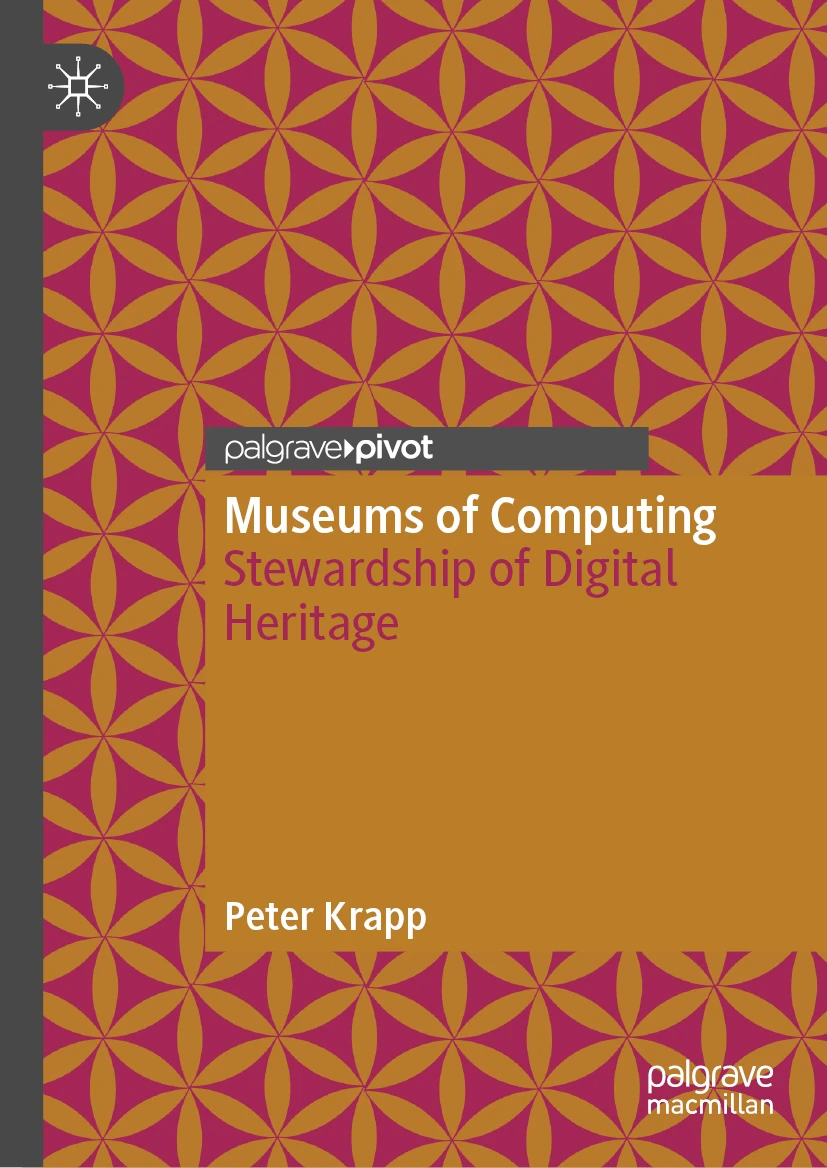

  • TitleMuseums of Computing:
    Stewardship of Digital Heritage
  • AuthorPeter Krapp
  • PublisherPalgrave Macmillan
  • Year2026
  • FormatHardcover, Paperback & eBook
  • ISBN-13978-3-032-33013-0 (eBook)
  • ISBN978-3-032-33012-3 (hard cover)
  • ISBN978-3-032-33015-4 (soft cover)
  • LanguageEnglish
  • SubjectsMuseum Studies · History of Computing · Digital Preservation · Media Studies · Library & Information Science
  • Springer LinkView on Springer ↗

What You'll Discover Inside

Six interlocking themes spanning collections management, digital preservation, institutional politics, and the future of computing heritage.

Collecting Computing Artefacts

The policies and practical challenges of deciding which hardware, software, and documentation enters a museum collection — and what is lost forever.

Conservation & Obsolescence

The unique conservation challenges of keeping electromechanical artefacts operational — and the ethical debates around restoration versus authentic decay.

Digital Cultural Heritage

How museums are grappling with the complex status of heritage objects in computing history — from preservation and restoration to replicas and emulators.

Understand legacy computing

Emerging museum practices exhibiting digital artefacts that never existed in physical form to broader audiences online.

Institutional Case Studies

Approaches at leading institutions that devote space and resources to the history of computing worldwide.

Stewardship of Digital Heritage

How institutions and communities can build sustainable stewardship frameworks for computing's ongoing legacy.

Chapter Overview

Click the colored labels to read more on each chapter.

  • 1
    Introduction:
    Foundations
    ▶
    Sets out the theoretical and historical case for computing as heritage — addressing why the computing past is underrepresented in cultural institutions and what is at stake in its preservation. Introduces the book's conceptual framework and methodology.
  • 2
    Science Museums:
    Institutions of Memory
    ▶
    What is the history of museums into which computer museums seek to inscribe themselves? What functions do museums of computing set out for themselves, and to what extent do they converge or diverge from those of other, older museums? What is digital heritage, and to what extent are computer museums helping people understand what is at stake?.
  • 3
    Digital Legacy:
    Collecting Computers
    ▶
    Traces the emergence of specialist computing museums from the 1970s to the present, examining the motivations of founders, the role of corporate and hobbyist communities, and the diverse institutional models that have developed globally.
  • 4
    Warp and Weft:
    Digital Aesthetics
    ▶
    What happens to our perception of older computers when they shift outside their original context and into a museum collection? How are historical devices transformed into aesthetic objects? What is the aesthetic potential of computer history?
  • 5
    The Beige Box:
    Personal Computing
    ▶
    What makes a vintage computer appealing today? Did the blandness of beige personal computers spur the musealization of older computing artifacts but not of mass-produced commodity devices and miniaturized integrated circuits?
  • 6
    Do Not Touch:
    Preservation, Replicas, Emulation
    ▶
    What options are available to museums of computing to keep the authentic look and feel of an interactive device, to keep an original interactive experience accessible? What is emulation, what role do replicas and restorations play in computer museums?
  • 7
    Dead Media:
    Deaccessioning and other Trade-offs
    ▶
    Are old computers more than mere dead media? When and why do computer museums discard what they accumulated? And what happens when computer museums fail?
  • 8
    Conclusion:
    Stewardship of Digital Culture
    ▶
    Synthesises the book's findings into an outlook on stewardship and working towards robust computing heritage practice.

A Taste of the Book

The following passage is drawn from the Introduction.

"Though the history of computing is still a fairly young field of research, we recognize in many publications the temptation to reduce it to listicls of reference devices or to the names of great inventors. An antiquarian approach that musealizes the legacy of vintage computing devices can be fascinating, but most computer museums are even younger than systematic studies in the history of computing, and placing old devices under protective glass only goes so far in promoting appreciation and understanding of contributions made or opportunities forgotten. Critical history would not indulge in the worship of heroes, for it is very aware of how fragile the current state of knowledge may be, nor is it content with anecdotes about obscure devices and their representation and preservation. The rapid growth in the number of computer museums from the 1990s onwards is not only a function of the profits that resulted from privatizing the backbone of the internet, but also an indicator of the transition from computing as an industry mainly serving corporate and government customers to one addressing individuals and households, from a select user base of professionals to a mass user base, from a scarcity of digital communications to their omnipresence. This development went hand in hand with a commercialization of digital networks, reflecting the rate of change people perceived in their own lifetime and encouraging the preservation of the remains of vanished worlds for future benefit."

What Reviews Are Saying

Endorsed by leading voices in museum studies, digital preservation, and the history of technology.

“Told through a focus on museums of computing, Krapp gives us an insightful, highly significant and elegantly written critical analysis of the cultures of collecting and memory institutions in the digital era. We get both a history of computers and digital culture, as well as a rigorous and sophisticated exploration of the place of the computer museum (and digital preservation) in supporting, reflecting, reinforcing and reproducing that culture.”

— Timothy Barker, Professor of Media Technology and Aesthetics, University of Glasgow, UK

"tba"

— nn /

Peter Krapp is Professor of Film & Media Studies at the University of California, Irvine, and associated with the Department of Music (Claire Trevor School of the Arts); for many years, he was also affiliated with the Departments of Informatics (Donald Bren School of Information and Computer Science) and of English (Humanities). His publications include Medium Cool (2002), Deja Vu: Aberrations of Cultural Memory (2004), Noise Channels: Glitch and Error in Digital Culture (2011), the Handbook Language-Culture-Communication (2013), and Computing Legacies: Digital Cultures of Simulation (2024). The latest is a book on Museums of Computing: Stewardship of Digital Heritage (London: Palgrave 2026).

For more information, check this bio blurb.

Where to Buy Museums of Computing

Available from all major academic and trade booksellers in hardcover, paperback, and digital formats.

Get 20% off with code PALAUT when ordering directly from Palgrave, or opt for an open access eBook

Selected talks focused on computing heritage and digital preservation.

18
Sept '26

Webinar“Museums of Computing”

🌐 Canadian Computing Heritage Network (CCHN) → York University

15
Jan '26

University“Ancient Computer Music”

📍 Defying Defaults in Technology and Culture, UC Riverside → UCHRI

3
Sep '25

Museum“Weft and Warp“

📍 Museo Cabañas → Guadalajara Mexico

11
Jul '25

Summer Academy"Historical Cryptology: Enigma Variations"

📍 ICS Summer Academy → UC Irvine

30
May '25

Conference“Memories of the Net“

📍 Cultural Studies Association Annual Conference → CalArts Valencia CA

24
Apr '25

Museum "Computing Legacies?"

🌐 Paul Gray Museum → Claremont CA (watch it on 🎥 YouTube)

25
Jan '25

Conference“Computers and Museums“

📍 Museums, Memory, Politics → Newcastle University UK

7
Nov '24

Conference“Emulation as Translation in Action“

📍 PAMLA → Palm Springs CA

23
Sep '23

University“Computational Aesthetics”

📍 Yonsei University → Seoul South Korea

20
Jun '23

Museum“Emulation and Replicas“

📍 Histocrypt 2023 → Science Museum Munich Germany

23
Nov '22

University“Is the Internet a Museum of Computing?”

📍 Zukunftskolleg → Konstanz University Germany

07
Nov '22

Webinar"Is the Internet a Museum of Computing?"

🌐 Week of the Image 2022 → São Leopoldo, Brazil YouTube

Reading Group & Classroom Guide

For museum studies, library and information science, history of technology, digital humanities, and professional development in the heritage sector.

📚 Discussion Questions

For seminars, reading groups, or professional development

  1. What distinguishes computing from other technological artefacts in terms of understanding our heritage?
  2. What is memory in computing, how has it changed over the history of computing?
  3. How does the legal status of software complicate museum collecting?
  4. As historians re-evaluate the legacy of older computing devices, what are some reasons for revisions?
  5. If stories are missing from computing museums, what are some structural reasons for that?
  6. How can museums balance the impulse to keep old machines "working" against conservation ethics around authenticity and non-intervention?

🎓 Related Resources

Online references and visuals

  • 🖥️

    I am a Computer

    Awesome art photography featuring personal computers by James Ball aka Docubyte. View →

  • 📋

    Guide to Computing

    Awesome art photography featuring historical computers, again by James Ball aka Docubyte. View →

  • 🎥

    Starring the Computer

    A compilation of legacy devices with starring turns in film and television. Watch →

  • 🗺

    Selected Museums

    A directory of institutions from around the globe, with links. Explore →

Press Kit

Everything reviewers or conference organizers need — all in one place.

🖼 Book Cover
📸 Author Portrait
📋 Official Flyer (PDF)
❓ Interview Q&A
📖 Open Access (by chapters)
🎤 Bio Blurb